Category: B3 Blog

3 Feb 2026 Recap

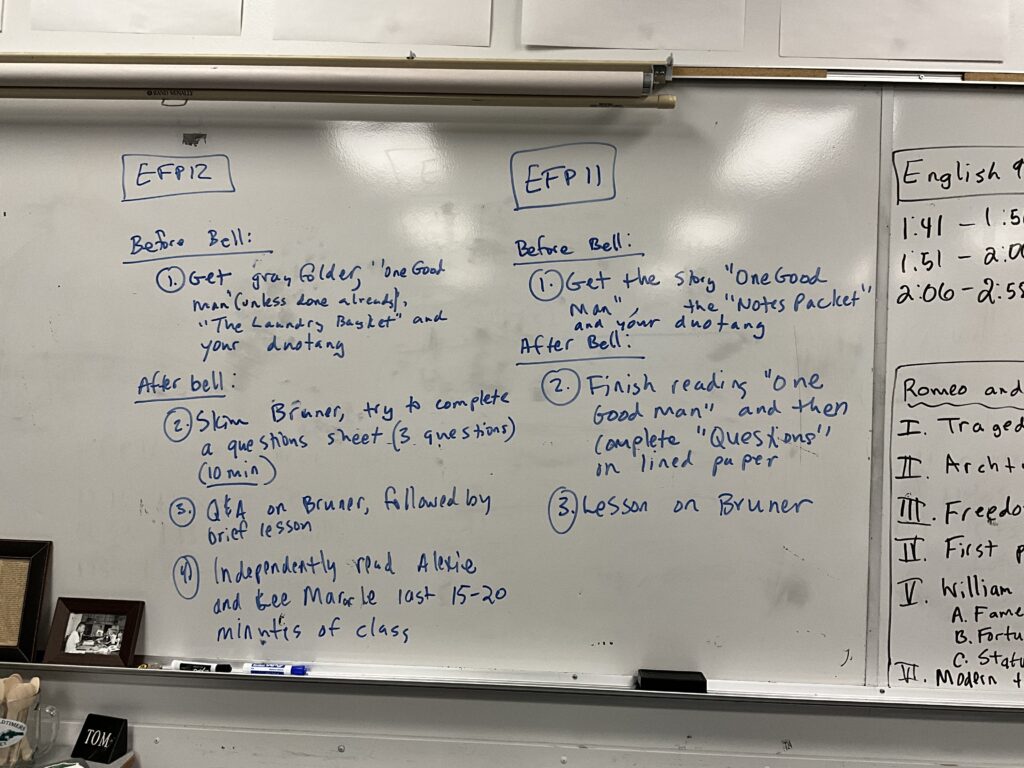
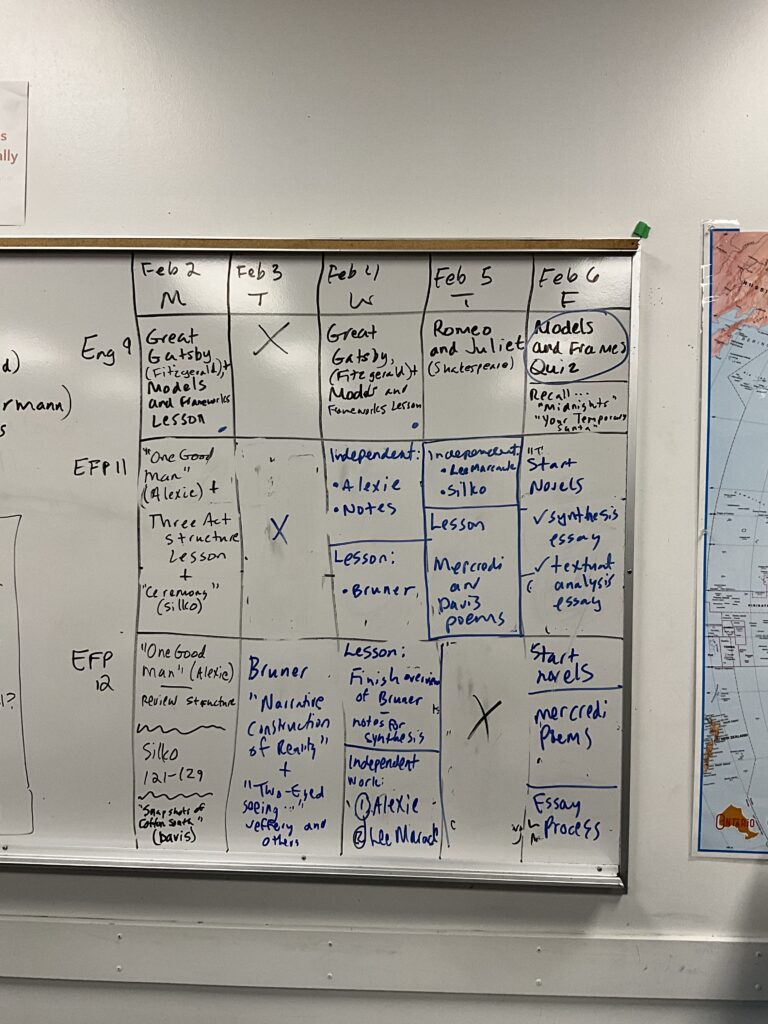
Activities today:

  1. Finish reading “One Good Man” (Alexie)
  2. Use the “questions” template for notes
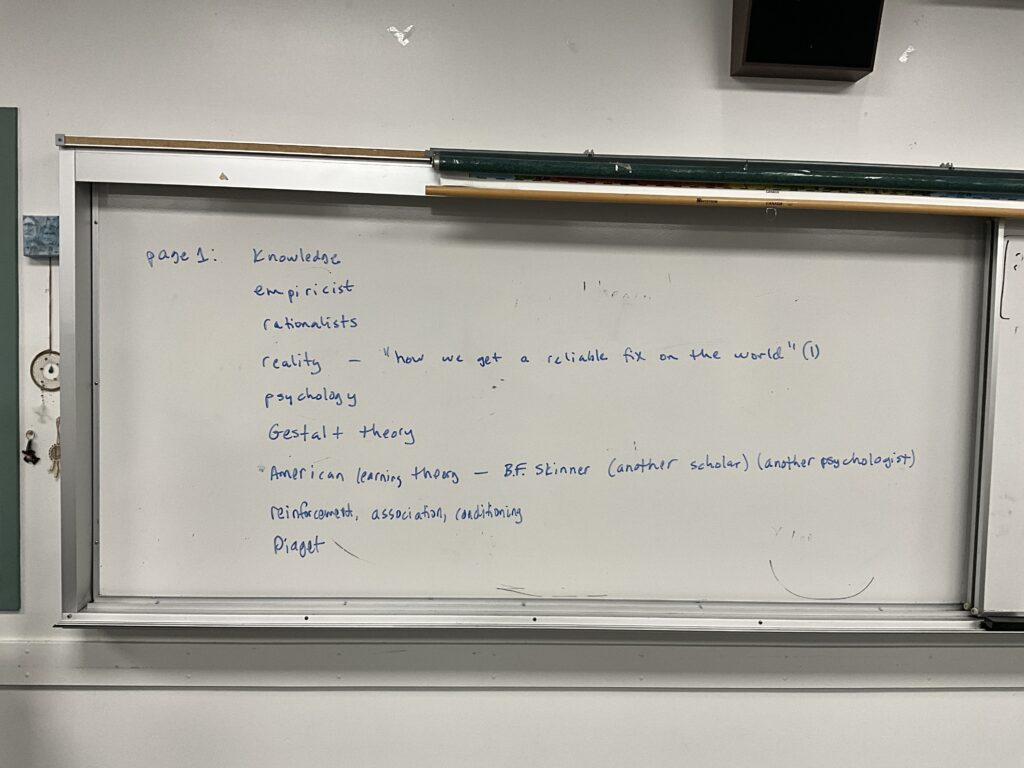
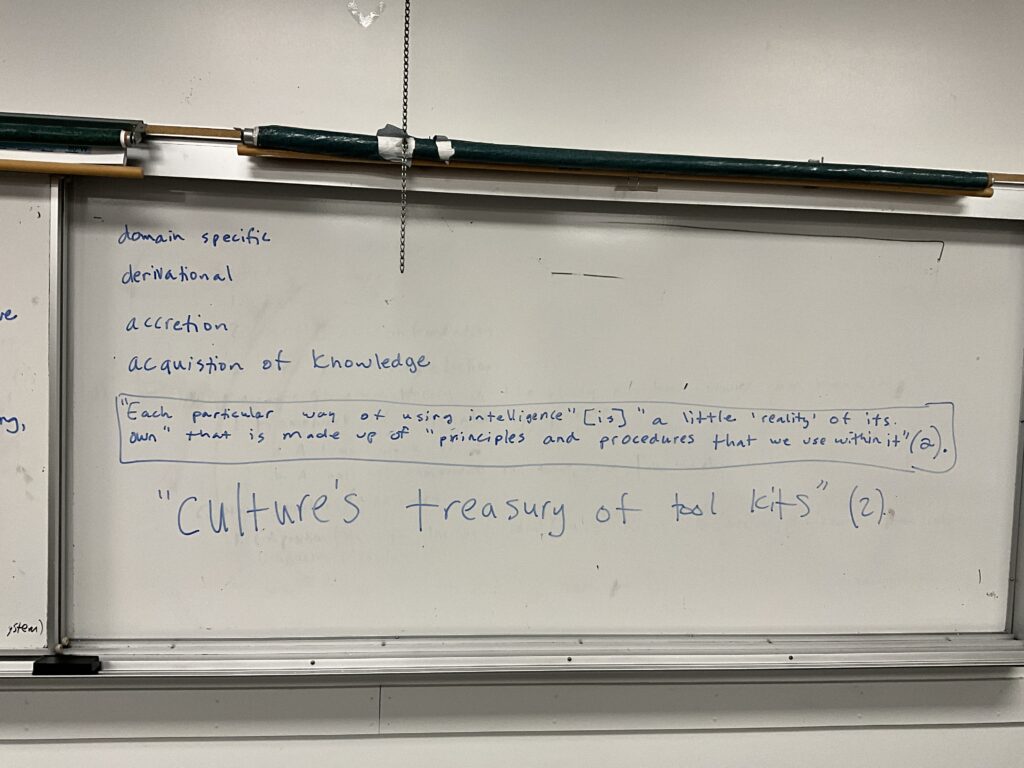
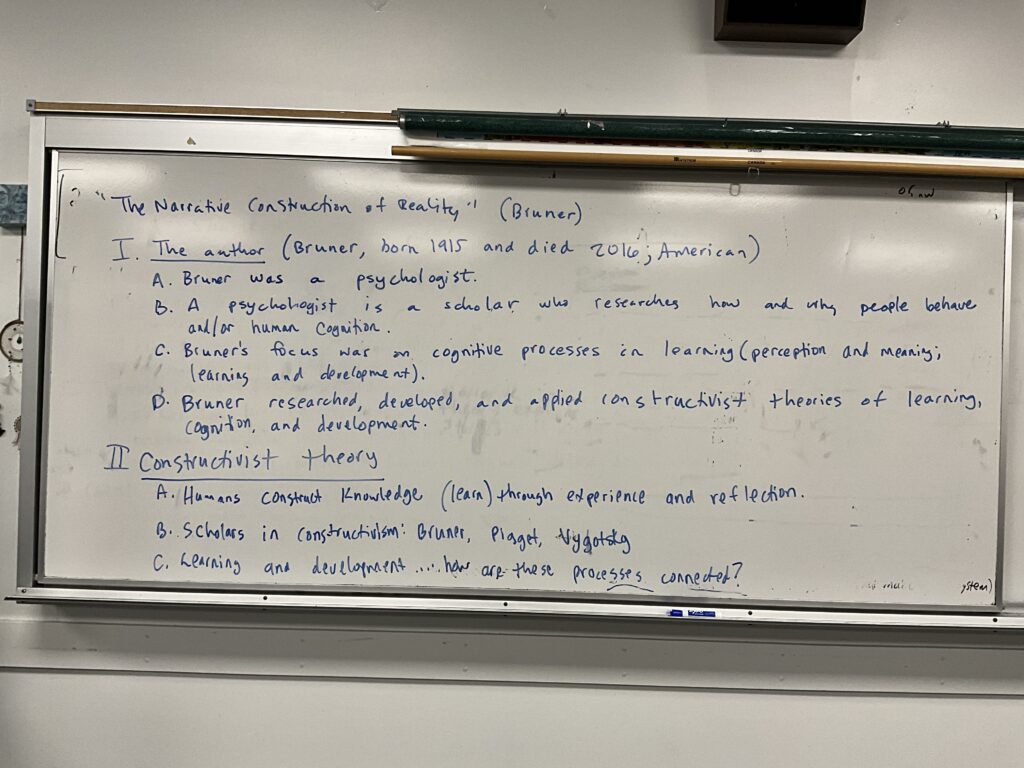
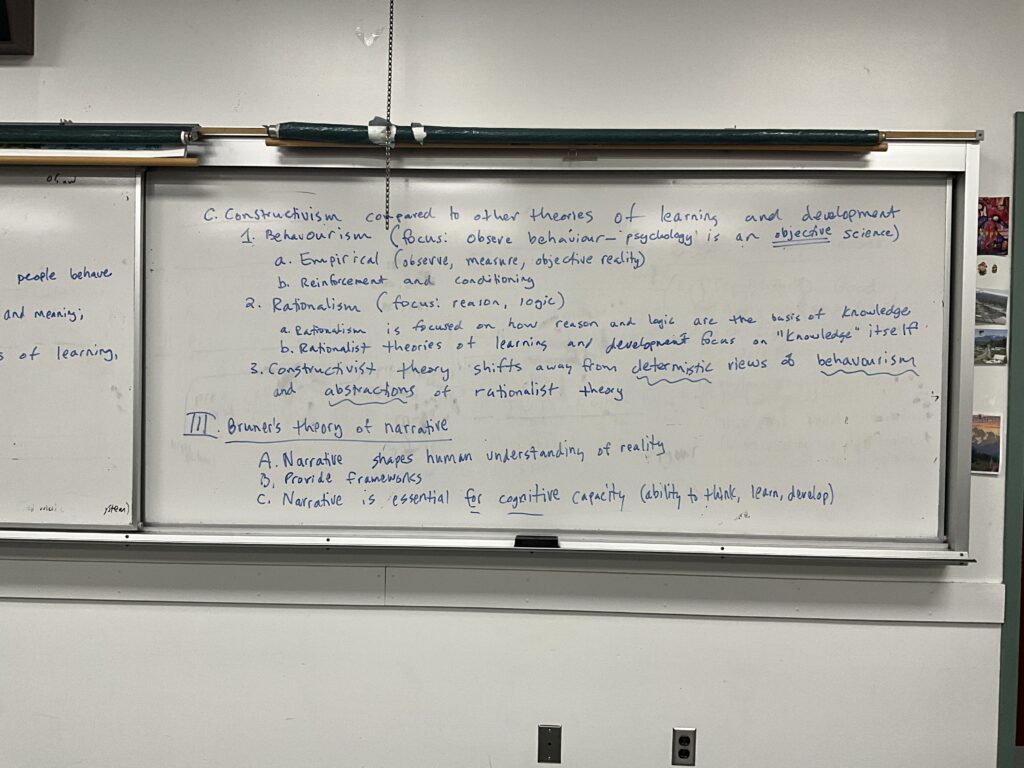
  3. Skim “The Narrative Construction of Reality” (Bruner)
  4. Skim and use the notes from week 1
  5. Briefly look over “Two-eyed seeing” articles (we will get to this later)
  6. Go over in detail the packet of readings for the synthesis essay
  7. Opening discussion on narrative theory and opening discussion on “The Narrative Construction of Reality” (Bruner)

Learning goals today:

  1. I will know how to use articles to find passages and quotes that I can connect to what I do know (so I can participate in a class discussion).
  2. I will know how to pay attention to all of the details and to all of the key ideas, including by taking notes, following each step, asking questions, and paying attention.
  3. I will know how the short story reports fit into the overall course plan, especially if I am aiming to achieve high school level reading (50-65).
  4. I will know how the synthesis essay fits into the overall course plan, especially if I am aiming to achieve pre-university level reading (75-100). Related, I will know how the synthesis essay fits into the textual analysis essay.
  5. I will see a connection between the readings in the gray duo tang and the synthesis essay and/or the textual analysis essay. I also know that Harold Johnson is a good place to start (and for students aiming for high school level reading a good place to perhaps stop and stay).
  6. I will how to read a text that is above my current level, I will know how to skim a text and use connections, I will know how to question and probe, and I will know how to discuss something that I am uncertain or unclear about. I will learn how to “be comfortable” with not knowing. And with this, I will know how to use what “I do know” to learn how to read.
  7. I will gain experience working in the format of a class discussion at the pre-university level. Specifically, I will:
    • Read ahead by skimming and finding things of interest.
    • Take notes and write reflections.
    • Be prepared to “just wing it” when asked to discuss something new or difficult, always bringing it back to “what I do know” and always bringing it up to “what I will know next”.
    • Break things into steps and chunks.
    • Focus on vocabulary.
    • Use the structure of the text to start to “get it”.
    • Volunteer what I know…
    • Risk being wrong when I am uncertain.
    • Recognize that these discussions are HOW to learn to read at advanced levels (that is why we do them in high school, college, and university)
  8. I will learn the format for how to speak in a discussion on a difficult text:
    • Find a passage
    • Tell the others where it is
    • Read it
    • Explain, question, or connect
    • Dig in deeper
    • Again: Say something (say what you DO know, say what you DON’T know, say SOMETHING… ANYTHING)

Key concepts:

  1. The synthesis essay is one section of the textual analysis essay
  2. The textual analysis essay will include a section on your theory of narrative (a synthesis)
  3. Your theory of narrative will include Indigenous perspectives and may also include Western or other non-Indigenous perspectives
  4. Students focused on high school level work should focus on the short story reports
  5. Students focused on high school level work should participate in discussions but not worry if they understand all of it (focus on what you do know, what you do care about, what you bring to the table)
  6. Students focused on pre-university level work should focus on the development a theory of narrative
  7. Your theory of narrative should have a trunk, branches, and ornaments and it should have roots
  8. A theory is simple to come up with; the challenge in convincing the reader why your theory matters and in explaining the details of it (applications, development, support, significance)

Summary:

Today was the last lesson on why you will write the short story reports (to learn to read) and why you are writing the textual analysis essay (to learn to read). It is also the last overview of how to write the textual analysis essay in terms of how the synthesis essay fits into it and how the related readings connect to this. Next you will do the reading to prepare for the essay and then you will draft, revise, and edit the essay. Through this process you should understand how the big ideas of Sara Florence Davidson, Lee Maracle, Leslie Silko, Brian Maracle, Harold Johnson, Jerome Bruner, Lev Vygotsky, Antonio Gramsci are connected to narrative, the basis for your own theory (synthesis) of narrative. One final note: We discussed how Harold Johnson’s passage is the most accessible and directly useful for most students in this class (so you may want to focus on his writing).
Key Dates Semester 2 2026

Informal Meet and Greet with Mr. Kertes

  • Informal Meet and Greet: Feb. 4 from 4:30-5:30 PM or 6:30-8:30 PM (room 308 at CHSS)
    • Drop-in
    • Optional
    • No need to RSVP

Informal Progress Report Dates

Informal progress reports are provided to each student on the dates below. I provide these as a way to let students know their progress throughout the semester. I email informal reports to parents/guardians only if a student is not passing, unless a parent/guardian requests to have it emailed either way. If you have questions about informal progress reports, please contact Mr. Kertes directly at 778-884-5343 (text is best) or tomkertes@sd52.bc.ca.

  • Progress Report #1: March 3
  • Progress Report #2: April 15 or 16
  • Progress Report #3: June 1

Report Cards and Conferences

The school has midterm learning updates and final semester learning updates (report cards). Please contact the school’s office for more information how to access your child’s learning update (report card). The school also has conferences, which are scheduled through the office. If you have any questions about report cards or conferences, please contact the school’s office.

  • End of Term A: April 15 or 16 (make up day is April 17)
  • End of Term B: June 19 (make up day is June 22)

English Class Exam Dates

  • Midterm Exam: April 10 to April 16
  • Final Exam: May 19 to May 25

English Class Major Assignment Due Dates

  • The major assignments (essays, creative writing, etc.) are all due on:
    • June 19
  • June is mostly “work blocks” for students to finish the major assignments

English 9 Key Dates

  • March 12 – Storytelling Day (visit an elementary school class to tell a story)
  • March 13 – Creative Writing Assignment due (short story first draft due)
  • April 10 to 16 – Midterm Exam Week
    • Learning Story Part 1
  • April 15 – Comparative Essay (1st and 2nd drafts) due
  • May 4 – Creative Writing Presentations
  • May 19 to 25 – Final Exam Week
    • Expository Essay (Theme: Love as an Idea)
  • June 15 to 18 – Metacognition Exam (Key Concepts and Learning Story Part 2)
    • Synthesis Essay (Topic: Zone of Proximal Development)
  • June 19 – Major Assignments Due
    • Comparative Essay (Topic: The Great Gatsby and Romeo and Juliet)
    • Textual Analysis Essay (Topic: Animal Farm or Measure for Measure)
    • Persuasive Essay (Theme: Reading as Resistance)

English First Peoples 11 Key Dates

  • Mar 2
    • Pre-University Skills and Concepts Test
  • Mar 2
    • Notes and Summaries Due
  • Mar 12
    • Storytelling Day (field trip to elementary school)
  • Mar 13
    • Creative writing assignment due
  • Mar 13
    • Storytelling reflection assignment due
  • Apr 10-16
    • Midterm Exam
  • Apr 15
    • Synthesis Essay due
  • Apr 15
    • Short Story Reports (1, 2, and 3) due
  • May 4
    • Policy Symposium Presentation due
  • May 19-25
    • Final Exam
  • May 26-29
    • Presentation due
  • June 19
    • Expository Essay due
    • Persuasive Essay due
    • Creative Writing (revised) due
    • Synthesis Essay (revised) due
    • Textual Analysis Essay due

English First Peoples 12 Key Dates

  • Mar 2
    • Pre-University Skills and Concepts Test
  • Mar 2
    • Notes and Summaries Due
  • Mar 12
    • Storytelling Day (field trip to elementary school)
  • Mar 13
    • Creative writing assignment due
  • Mar 13
    • Storytelling reflection assignment due
  • Apr 10-16
    • Midterm Exam
  • Apr 15
    • Synthesis Essay due
  • Apr 15
    • Short Story Reports (1, 2, and 3) due
  • May 4
    • Policy Symposium Presentation due
  • May 19-25
    • Final Exam
  • May 26-29
    • Presentation due
  • June 19
    • Expository Essay due
    • Persuasive Essay due
    • Creative Writing (revised) due
    • Synthesis Essay (revised) due
    • Textual Analysis Essay due

Informal Meet and Greet with Mr. Kertes

Dear Parents/Guardians (Eng 9, EFP 11, EFP 12):

I am Mr. Kertes and I teach English 9, English First Peoples 11, and English First Peoples 12 this term at CHSS.

At the start of each term I invite families to attend an informal (optional) “meet and greet” or open house in my classroom (room 308 at CHSS).

Please feel free to stop by to ask any questions or to learn more about your child’s upcoming course.Many families use this time to let me know about supports your child needs or questions your child has about the course.

  • Who: Families/students in any Mr. Kertes class this term
  • What: Informal (drop-in) meet and great (open house)
  • Where: Room 308 at CHSS
  • When: Wednesday February 5th:
    • 4:00-5:00 PM (drop-in, no need to RSVP) OR
    • 6:30-8:30 PM (drop-in, no need to RSVP)

If you cannot attend but would like to speak with me, please text me at 778-884-5343 and we can set up a time to talk by phone or in person on another day. Text is the best way to reach me. Please let me know if you have any questions or ways I can support your child’s learning at school. Text is usually best or you can send an email. Feel free to do this at anytime during the semester.

Mr. Kertes
English Teacher

778-884-5343
tomkertes@sd52.bc.ca

Contact

Introduction: Mr. Kertes di waayu. Kittitas ada Boosn di wil ‘waatgu. Canadian ada Boosn 'nüüyu. Kxeen di wil dzogu. Adabiis di pdeegu.

About: Mr. Kertes is a high school English teacher in Prince Rupert, which is in the territory of the Ts’msyen, at Charles Hays Secondary School (CHSS) - home of the Rainmakers. The language of the Ts'msyen is Sm’algya̲x.

Education: Master in Educational Leadership (2019) (VIU); Bachelor of Education: Indigenous Perspectives in Education (2014) (SFU); Diploma: Early Childhood Education (including Infant/Toddler) (2010) (Langara); Graduate Studies: Human Development and Applied Psychology (2008-2009) (OISE/U of T); Bachelor of Arts: Psychology (2003) (University of Washington)

Experience: English teacher at CHSS (2023-current); Grade 7 teacher and Drama 8 teacher at PRMS (2018-2023); English teacher and Drama teacher at Gidg̱alang Ḵuuyas Naay (2016-2018); Teacher at Sk’aadgaa Naay Elementary and Tahayghen Elementary (2015); Early Childhood Educator at UBC (2010-2013); Policy and Communications Advisor at Ontario's self-regulatory College of Early Childhood Educators (2009-2010); Instructor – Early Childhood Education and Child Development at Seneca College (2008); Executive Director at Pike Market Child Care (2003); Director of Learning Services at Puget Sound Learning (1994-2000); Early Childhood Educator – Children’s Garden Preschool (1997-2000)

Thomas W. Kertes CV (pdf)

Tom Kertes Resume